In just 18 months, Android has come from nowhere to become the mobile OS powering just under half of all smartphones sold in the UK
Figures from Kantar ComTech show how dramatically Android has risen to prominence - but what does that mean for rival contenders such as Nokia, Apple and RIM?
In just 18 months, Android has come from nowhere to become the mobile OS powering just under half of all smartphones sold in the UK – and half the people owning a mobile phone in the UK have a smartphone.
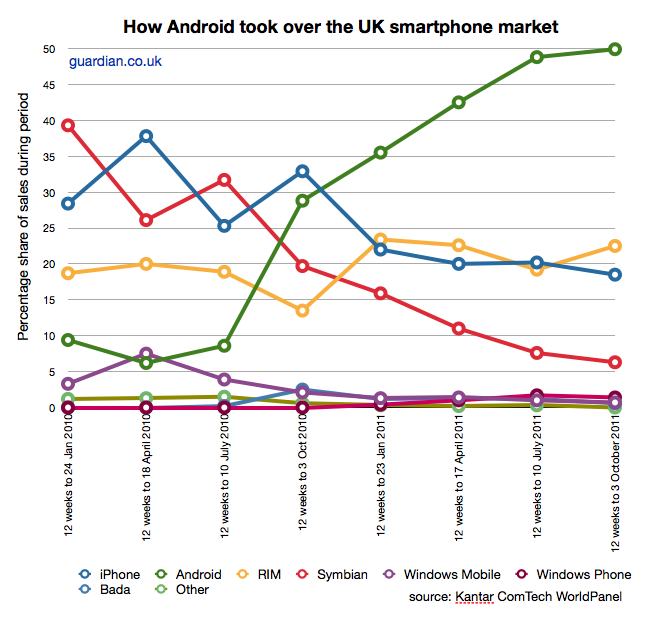
In the process it has bested Nokia's Symbian (since declared dead, though still stumbling to its grave), RIM's BlackBerry OS (which is fighting back) and Apple's iPhone (which, given its comparatively high price until the latest cuts to the iPhone 3GS and iPhone 4, was never likely to dominate long-term).
It's an amazing run for Android which is likely to carry on into 2012, since it's taken four years to reach this point (longer if you count Nokia's, RIM's and Microsoft's offerings from 2005/6 as smartphones) but the number of smartphones being sold is accelerating.
What these figures don't show you is that the entire market is growing; Kantar ComTech WorldPanel, which provides the statistics, declined to give absolute sales figures (they want to have something to tempt clients to buy the full reports). A minor note: these figures go up to 2 October, just before the iPhone 4S launch; expect that Apple's share will recover slightly. Even so, Android is just going to keep growing.
It's very likely that in the next two years you'll see smartphones reach something like 90% penetration in the UK - if only because fewer shops and carriers will be selling feature phones, for two reasons: (a) they make less money selling them in the first place (b) carriers get less money from phones that don't have data plans.
Android is almost certain to sweep the board here: it could hit up to 70% market share in one or two years (remember, market share is "share of handsets being sold", not "share of handsets in peoples' hands"). That's because Android handsets from cheaper manufacturers such as China's Huawei and ZTE will come in at the bottom of the market (it's noticeable how the "Other" segment has fallen to zero in the past year). Pretty soon you're going to be able to get a smartphone for almost nothing in your local supermarket. And you can already get really cheap PAYG data options from Three or GiffGaff.
For the record, I think it's great that smartphones are becoming pervasive. Putting the internet in everyone's hands, wherever they are? (If only the mobile carriers would stop holding up the 4G auction.) That's got to be a really good thing.
Does it matter, though, whether the pervasive OS is Android, or what share this or that OS has, beyond the willy-waving horse race that some people love to indulge in? Here's Henry Blodget over at BusinessInsider, who slams on the CAPS LOCK to pronounce ATTENTION APPLE FANS: Samsung Blowing Past Apple To Become The Biggest Smartphone Vendor Is Not Good News". (By which he means not good news for Apple. Though by implication, it would also be Not Good News for RIM and Nokia either.)
Read more at:
http://www.guardian.co.uk/technology/2011/oct/31/android-uk-smartphone-growth
In just 18 months, Android has come from nowhere to become the mobile OS powering just under half of all smartphones sold in the UK – and half the people owning a mobile phone in the UK have a smartphone.
In the process it has bested Nokia's Symbian (since declared dead, though still stumbling to its grave), RIM's BlackBerry OS (which is fighting back) and Apple's iPhone (which, given its comparatively high price until the latest cuts to the iPhone 3GS and iPhone 4, was never likely to dominate long-term).
It's an amazing run for Android which is likely to carry on into 2012, since it's taken four years to reach this point (longer if you count Nokia's, RIM's and Microsoft's offerings from 2005/6 as smartphones) but the number of smartphones being sold is accelerating.
What these figures don't show you is that the entire market is growing; Kantar ComTech WorldPanel, which provides the statistics, declined to give absolute sales figures (they want to have something to tempt clients to buy the full reports). A minor note: these figures go up to 2 October, just before the iPhone 4S launch; expect that Apple's share will recover slightly. Even so, Android is just going to keep growing.
It's very likely that in the next two years you'll see smartphones reach something like 90% penetration in the UK - if only because fewer shops and carriers will be selling feature phones, for two reasons: (a) they make less money selling them in the first place (b) carriers get less money from phones that don't have data plans.
Android is almost certain to sweep the board here: it could hit up to 70% market share in one or two years (remember, market share is "share of handsets being sold", not "share of handsets in peoples' hands"). That's because Android handsets from cheaper manufacturers such as China's Huawei and ZTE will come in at the bottom of the market (it's noticeable how the "Other" segment has fallen to zero in the past year). Pretty soon you're going to be able to get a smartphone for almost nothing in your local supermarket. And you can already get really cheap PAYG data options from Three or GiffGaff.
For the record, I think it's great that smartphones are becoming pervasive. Putting the internet in everyone's hands, wherever they are? (If only the mobile carriers would stop holding up the 4G auction.) That's got to be a really good thing.
Does it matter, though, whether the pervasive OS is Android, or what share this or that OS has, beyond the willy-waving horse race that some people love to indulge in? Here's Henry Blodget over at BusinessInsider, who slams on the CAPS LOCK to pronounce ATTENTION APPLE FANS: Samsung Blowing Past Apple To Become The Biggest Smartphone Vendor Is Not Good News". (By which he means not good news for Apple. Though by implication, it would also be Not Good News for RIM and Nokia either.)
Read more at:
http://www.guardian.co.uk/technology/2011/oct/31/android-uk-smartphone-growth
posted by Digital Amber at
14:04


0 Comments:
Post a Comment
Subscribe to Post Comments [Atom]
<< Home